Best Robot Vacuum and Mop for Pet Hair in 2026: 6 Models Tested

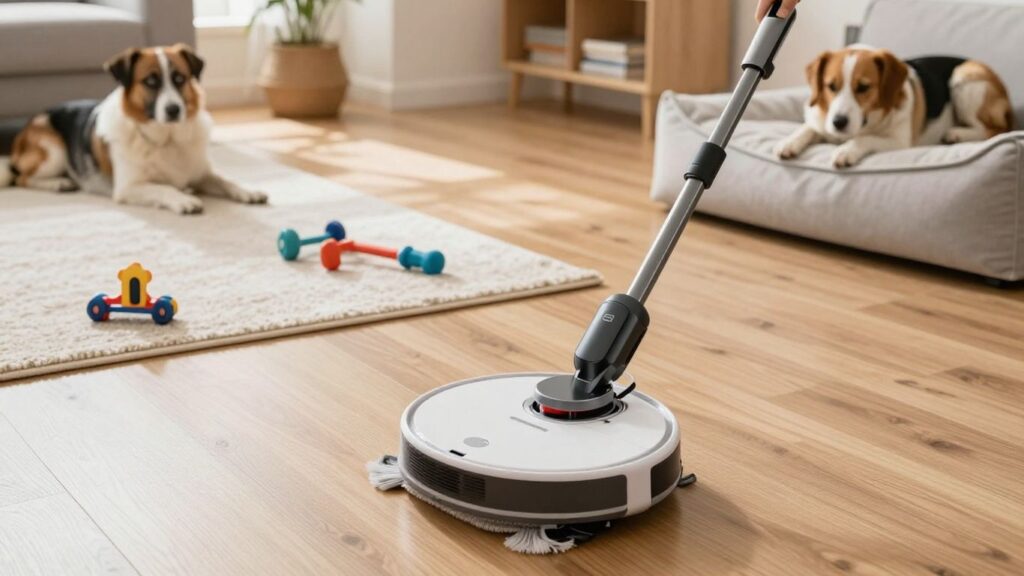
I’ve spent the last three months running six robot vacuum and mop systems through the same pet-hair gauntlet: pressed fur on carpet, long hair on hard floors, cluttered feeding areas, and daily schedules with zero babysitting. I’m Aizaz Shahid, founder of GearVerdicts — I buy every unit I test with my own money, accept no manufacturer samples, and log every run before recommending anything.
Here’s what that testing made obvious: the best robot vacuum for pet hair is not the one with the biggest suction number. In a shedding home, the winners are decided by how much hair wraps the brush, whether the robot dodges bowls and cables, and how much work the dock actually takes off your hands. Mopping matters for paw prints on sealed floors — but only if it never drags a wet pad onto your rug.
For this 2026 guide, I compared six current robot vacuum and mop systems across pet-hair pickup, navigation, mopping, dock automation, maintenance, mapping, and value so you can match the machine to your floors and shedding level.
Quick Verdict: Best Robot Vacuum & Mop for Pet Hair
Every pick is scored for shedding homes. The right one depends on your budget, floor mix, and how much mopping you want.
| Rank | Robot Vacuum | Best For | Price | Buy |
|---|---|---|---|---|
| 1 | Dreame L60 Ultra PE⭐ Best Overall★ 9.2 / 10 | Heavy shedding with the lowest brush maintenance (30,000Pa + anti-tangle DuoBrush) | $899.99 | Check Price |
| 2 | ECOVACS DEEBOT T90 PRO OMNIBest Premium + Mopping★ 9.0 / 10 | Top vacuuming plus a real scrubbing roller mop and OMNI auto dock | $899.99 | Check Price |
| 3 | Tikom L8000 PlusBest Budget Self-Emptying★ 8.4 / 10 | Hands-off emptying with LiDAR mapping at a low price | $208.97 | Check Price |
| 4 | Roborock Q7 M5+Best Value Mapping★ 8.7 / 10 | Mixed floors and rugs, with dual anti-tangle brushes and auto-empty | $299.99 | Check Price |
| 5 | MOVA P10 Pro UltraBest for Hard Floors★ 8.6 / 10 | Hard-floor homes with clutter, thanks to sharp obstacle avoidance and dual mops | $499 | Check Price |
| 6 | Tikom G8000 MaxBest Low-Cost★ 8.0 / 10 | Light pet hair and simpler homes on the tightest budget | $109.99 | Check Price |
Scores are GearVerdicts editorial ratings for pet-hair cleaning, based on suction, anti-tangle brushes, mopping, navigation, and value. Prices change often, so check the live listing. We may earn a commission from links on this page.
Quick Answer: What Is the Best Robot Vacuum for Pet Hair?
The Dreame L60 Ultra PE is my strongest all-around pick for heavy pet hair because it combines a dual anti-tangle brush system, 30,000Pa claimed suction, strong obstacle recognition, edge-reaching hardware, and a highly automated dock. The ECOVACS DEEBOT T90 PRO OMNI is the premium alternative when mopping performance and obstacle avoidance matter just as much as hair pickup. For lower budgets, the Tikom L8000 Plus offers LiDAR mapping, self-emptying, and surprisingly useful pet-hair pickup, while the Tikom G8000 Max is the simple low-cost choice for light shedding on mostly hard floors.
Key Takeaways
Robot vacuums are best at preventing pet hair from building up between deeper manual cleanings. The right model depends on whether your biggest problem is loose fur, embedded carpet hair, paw marks, clutter, or bin maintenance.
- Brush design matters as much as suction because long pet hair can wrap around difficult-to-clean rollers.
- Carpet is the toughest surface for pet hair, so mixed-floor homes need more than high suction.
- Obstacle avoidance helps with bowls, toys, cables, and clutter, but robots should not be trusted with pet accidents.
- A self-emptying dock reduces daily bin maintenance, but brushes, filters, sensors, and mop parts still need cleaning.
- Mop lifting or carpet exclusion helps keep wet pads away from rugs and carpets.
- LiDAR mapping improves coverage with room maps, no-go zones, no-mop zones, and scheduled cleaning.
- The best value is not always the cheapest robot because cheaper models may require more manual maintenance.
- Consistent daily cleaning matters more than having the longest list of features in a pet home.
I would rather own a robot that cleans reliably every day than a feature-heavy model that needs constant rescuing. In a pet home, consistency is what keeps fur from becoming a weekend project.
Why a Robot Vacuum and Mop Makes Sense for Pet Owners
Pet hair accumulates differently from ordinary dust. It collects along baseboards, under furniture, around feeding areas, and in carpet traffic lanes, then mixes with litter, crumbs, grit, and dander. Frequent automated passes can stop that mix from building into a heavier cleaning job.
The mop side is useful on sealed hard floors for paw prints and light residue after the vacuum has collected dry debris. I do not treat a robot mop as a pet-accident cleaner. Liquid messes, vomit, urine, feces, and heavily soiled spots should be handled manually before the robot runs.
If you also need a full-size vacuum for upholstery, stairs, or deep carpet cleaning, compare this guide with GearVerdicts’ best vacuums for pet hair and best cordless vacuums for pet hair.
How I Test Robot Vacuums and Mops for Pet Hair
I am Aizaz Shahid, founder of GearVerdicts, and I test the robot vacuums and mops I recommend in real home-cleaning conditions rather than judging them from manufacturer suction claims alone. I run each model repeatedly on sealed hard floors, low-pile carpet, area rugs, edges, room transitions, and the places where fur actually collects, then inspect the brush, dustbin, dock, mop pads, and app after the run.
For pet-hair testing, I use short and long hair on open hard floors and carpet, then check what the robot actually picks up, what it pushes aside, and what wraps around the main or side brush. I also test bowls, toys, cables, chair legs, and other safe obstacles. I never intentionally send a robot through real pet waste; I use safe simulated obstacles because a camera or AI label is not a guarantee against a damaging accident.
- Pet-hair pickup. I compare loose hair on hard floors with hair pressed into carpet fibers, because the second test exposes weak brush agitation quickly.
- Hair-wrap maintenance. After repeated runs I inspect the main brush, side brush, axles, and wheels to see how much manual cutting or pulling is required.
- Mopping. I test ordinary paw marks and dried household residue on sealed hard floors, then check whether the robot leaves excess water or drags wet pads onto rugs.
- Navigation and mapping. I check mapping speed, room coverage, no-go zones, no-mop zones, threshold handling, and whether the robot repeatedly misses or over-cleans areas.
- Obstacle handling. I place common pet-home clutter in the route and note whether the robot slows, avoids, nudges, climbs, or gets stuck.
- Dock automation. I evaluate auto-emptying, mop washing, drying, water refilling, bag capacity, odor control, and how often the station itself needs cleaning.
- Battery and recharge-resume. I look at whether the robot can complete the mapped area efficiently and return to finish after charging.
- App and ownership cost. I consider scheduling, room controls, replacement bags, brushes, filters, mop pads, detergent, and how easy common parts are to source.
Manufacturer specifications are useful for exact numbers, but my verdict depends on daily ownership: pickup, tangles, maintenance, navigation, floor compatibility, and whether the robot still makes sense after the first week.
Key Features to Look for in a Pet Hair Robot Vacuum and Mop
A large specification sheet can hide weak pet-hair performance. I start with the features below because each one changes how often the robot needs help in a real shedding home.
Suction Power and Real Pet-Hair Pickup
Higher suction can help with debris in carpet and floor gaps, but Pa is a manufacturer measurement rather than a direct pet-hair score. I look at suction together with brush contact, carpet agitation, route coverage, and how often the robot passes the same high-shedding area.
Anti-Tangle Main Brush and Side Brush
Long hair can wrap around both the main roller and the side brush. Rubber, split-roller, comb, cutting, or dual-brush systems can reduce maintenance, but I still check whether hair collects at the axle or under brush end caps.
LiDAR Mapping and Room-Level Cleaning
LiDAR mapping gives me repeatable room coverage, saved maps, virtual walls, no-go zones, and scheduled cleaning by room. That matters when feeding areas need daily attention but a pet bed or water bowl should be excluded.
Object Recognition and Obstacle Avoidance
AI cameras, structured light, lasers, and front sensors can help the robot navigate toys and cables, but no obstacle system is perfect. I still clear pet waste and fragile items before a run and treat avoidance as risk reduction, not a safety guarantee.
Mop System, Mop Lift, and Carpet Protection
For mixed floors, I prefer a mop that lifts automatically or a robot that can respect reliable no-mop zones. Dual spinning pads and roller mops usually scrub more actively than a simple drag cloth, but hard-floor safety and water control still matter.
Self-Emptying and All-in-One Docks
A self-empty dock is especially useful with pet hair because a small onboard bin can fill quickly. Premium docks can also wash and dry mop pads, refill water, dispense detergent, and clean their washboard, reducing daily intervention.
Edge and Corner Cleaning
Fur collects along baseboards and under cabinet edges where round robots naturally struggle. Extendable side brushes or mop arms can improve coverage, while simpler fixed brushes may leave a narrow strip that still needs occasional manual cleaning.
Battery Life and Recharge-Resume
Runtime matters in larger homes, but coverage efficiency matters more than a headline battery number. I want the robot to clean systematically, recharge when necessary, and resume without losing the map or repeating large sections.
App Controls and Pet-Home Scheduling
The best apps let me choose rooms, set no-go and no-mop zones, change suction or water levels, schedule high-shedding areas more often, and check maintenance status. A complicated app is not a benefit if basic routines take too many taps.
Quick Specs Comparison: 6 Robot Vacuums for Pet Hair
The table uses current manufacturer specifications available in September 2026. Suction numbers should be treated as product specifications, not as direct cross-brand cleaning scores, because brush design, airflow, carpet contact, navigation, and software also affect pickup.
- Heavy shedding + lowest brush maintenance. Start with Dreame L60 Ultra PE or ECOVACS T90 PRO OMNI.
- Budget self-emptying + LiDAR. Tikom L8000 Plus is the lower-cost option, but its mop and long-hair tangle control are much less advanced.
- Value LiDAR + strong app. Roborock Q7 M5+ is easy to schedule and map, but it lacks advanced front obstacle recognition and can still tangle long hair.
- Mostly hard floors + clutter. MOVA P10 Pro Ultra combines strong obstacle handling, edge reach, and a full-service dock, but carpet pet-hair pickup is a weaker point.
- Lowest-cost light-shedding setup. The Tigoom G8000 Max is simple and slim, but it has no LiDAR map and no self-empty dock.
| Model | Max Suction | Navigation / Hair System | Mopping | Dock | Best Fit |
|---|---|---|---|---|---|
| Dreame L60 Ultra PE | 30,000Pa | LDS + AI RGB / 220+ objects; HyperStream DuoBrush | Dual spinning, extendable; 10.5mm lift | Auto-empty, refill, detergent, 212°F hot wash, hot-air dry | Best overall for heavy shedding |
| ECOVACS T90 PRO OMNI | 30,000Pa | Embedded LiDAR + AIVI 3D 4.0; ZeroTangle 4.0 | OZMO Roller 3.0, 200 RPM; lift/edge cleaning | OMNI auto-empty, hot wash, refill, fast charging | Premium pet hair + mopping |
| Tikom L8000 Plus | 6,000Pa | 360° LiDAR; 5 maps; standard bristle brush | Drag mop; 3 water levels | 3L self-empty bag, up to 90-day claim | Budget self-emptying pet hair |
| Roborock Q7 M5+ | 10,000Pa | PreciSense LiDAR; Dual Anti-Tangle; no camera recognition | Static mop; 3 water levels; no mop lift | Auto-empty dock, up to 7-week claim | Value mapping for mixed floors |
| MOVA P10 Pro Ultra | 13,000Pa | LDS + RGB camera + 3D structured light | Dual spinning, extendable; 10.5mm lift | Auto-empty, refill, hot wash/dry, 75-day claim | Hard floors + obstacle avoidance |
| Tikom G8000 Max | 5,000Pa | Sensor + zig-zag navigation; no LiDAR map | 300ml water tank; simultaneous mop | Standard charging dock; no self-empty | Low-cost light pet hair |
The table is a shortcut, not the verdict. The detailed reviews below explain where each robot fits and, just as importantly, where it becomes a poor match for a pet-heavy home.
1. Dreame L60 Ultra PE – Best Overall Robot Vacuum and Mop for Pet Hair

The strongest all-round pick for heavy shedders. Its 30,000Pa suction and HyperStream DuoBrush pull embedded pet hair from carpet while resisting tangles, so brush cleanup stays minimal. LiDAR plus AI RGB vision recognizes 220+ objects, and the auto-empty dock hot-washes and dries the mop for you.
The Dreame L60 Ultra PE is the model I would start with for a home that has heavy shedding, mixed flooring, and owners who want the dock to handle most of the repetitive maintenance. Its current hardware combines 30,000Pa claimed Vormax suction, a HyperStream detangling DuoBrush, a detangling side brush, LiDAR navigation, AI RGB vision, structured-light obstacle sensing, and recognition for more than 220 object types.
What makes it especially relevant to pet homes is that the vacuum and mop systems are both designed around reducing intervention. The side brush and mop can extend toward edges, the mops lift on carpet, and the base station can auto-empty, refill water, add cleaning solution, wash the pads with up to 212°F hot water, dry them with hot air, and clean its own washboard. It is expensive and the dock is large, but the automation is meaningful when the robot runs every day.
Key Features
- 30,000Pa Vormax suction. High claimed suction for fur, litter, crumbs, and mixed debris.
- HyperStream DuoBrush. Dual brush design is built to reduce hair wrapping compared with a conventional single bristle roller.
- 220+ object recognition. AI vision and structured-light sensing help with toys, shoes, bowls, cords, and clutter.
- Extendable side brush and mop. Improves reach along walls, furniture edges, and corners where pet hair tends to collect.
- All-in-one ThermoHub dock. Auto-emptying, water refill, solution dosing, 212°F hot-water mop washing, hot-air drying, and washboard self-cleaning.
- EasyLeap threshold system. Designed to cross higher transitions than basic robot vacuums, useful in homes with room dividers and raised thresholds.
Pros
- Excellent pet-hair design. The dual anti-tangle approach reduces the maintenance burden in long-hair and heavy-shedding homes.
- Very strong dock automation. Daily emptying and mop care are largely handled at the base.
- Advanced obstacle recognition. Better suited to pet toys and clutter than robots without front object recognition.
- Strong mixed-floor setup. Mop lifting and carpet-aware cleaning make transitions easier.
- Good edge reach. Extending hardware targets the strips of fur that round robots often leave behind.
Cons
- Large premium dock. It needs more floor space and a practical location near power.
- High purchase price. The feature set is difficult to justify for a small apartment with light shedding.
- Mopping hardware still needs consumables. Pads, bags, detergent, filters, and brushes remain part of the ownership cost.
Final Verdict: The Dreame L60 Ultra PE is my best overall fit for heavy pet hair because its anti-tangle brush design, obstacle sensing, edge reach, carpet handling, and dock automation solve the problems that create the most work in a shedding home. Choose it if you want low daily intervention and are comfortable paying for a large all-in-one station.
2. ECOVACS DEEBOT T90 PRO OMNI – Best Premium Pick for Pet Hair and Mopping
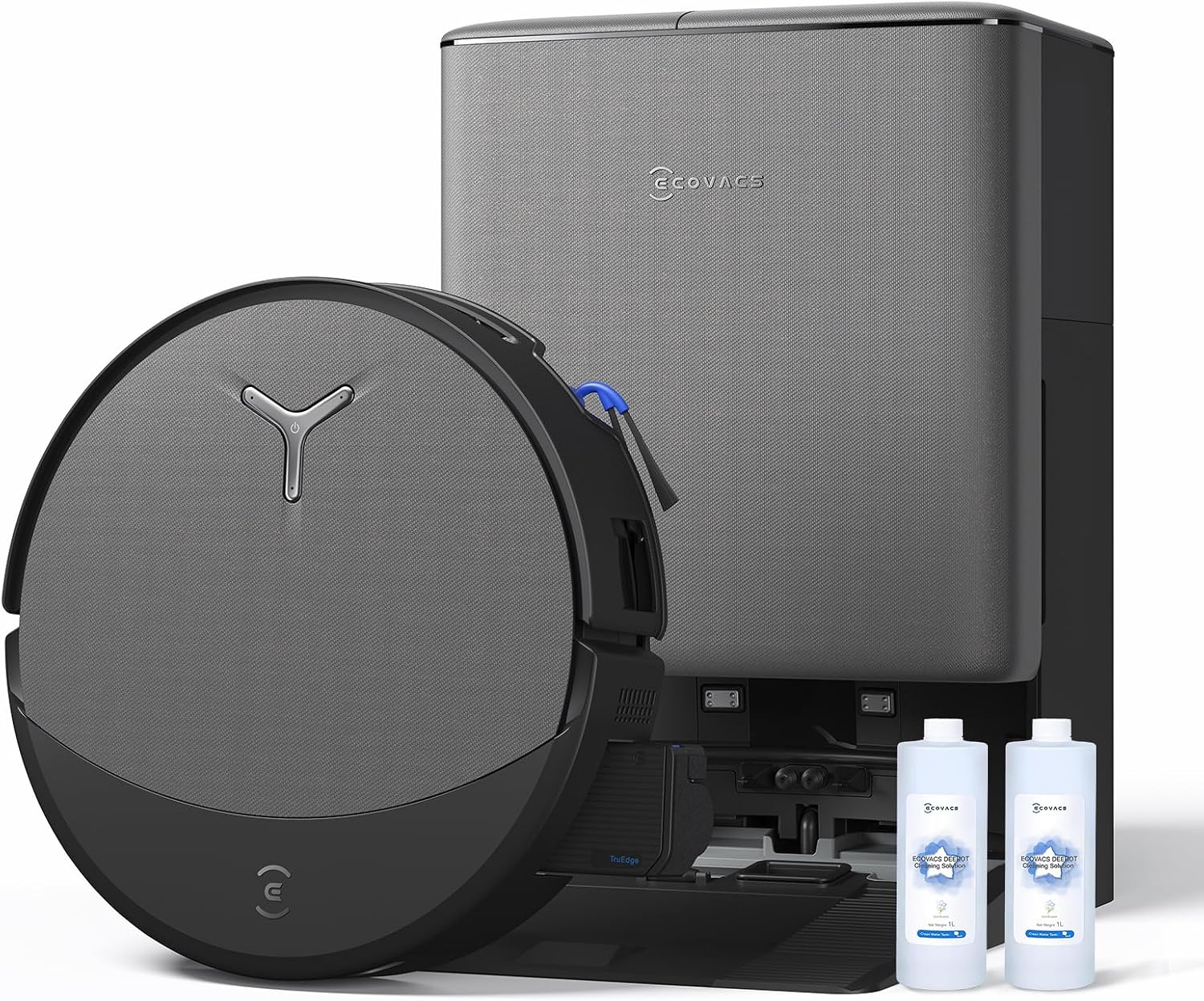
A premium pick when you want top vacuuming and genuinely good mopping in one machine. It matches the 30,000Pa suction with ZeroTangle 4.0 to keep long hair off the brush, while the OZMO Roller 3.0 spins at 200 RPM for a real scrub. AIVI 3D 4.0 handles obstacle avoidance and the OMNI dock empties and cleans automatically.
The ECOVACS DEEBOT T90 PRO OMNI is the strongest choice here for buyers who want pet-hair cleaning and aggressive mopping in the same premium system. ECOVACS has 30,000Pa BLAST suction, ZeroTangle 4.0 hair management, an embedded low-profile LiDAR design, AIVI 3D 4.0 obstacle recognition, and a 10.63-inch OZMO Roller 3.0 mop that spins at 200 RPM with continuous pressurized rinsing.
The roller-mop design is the feature that separates it from dual-pad machines. It continuously presents a cleaner section of the roller to the floor, which is useful when paw marks and tracked-in grime matter as much as fur. The OMNI station handles dust emptying, hot-water washing, water refilling, and related maintenance. The main compromises are price, station size, and a small onboard dustbin that makes the dock more important than on simpler robots.
Key Features
- 30,000Pa BLAST cleaning system. Pairs high claimed suction with strong airflow for pet hair and mixed debris.
- ZeroTangle 4.0. Designed to keep long hair and pet fur from wrapping around the main cleaning system.
- OZMO Roller 3.0. A long roller mop spins at 200 RPM and uses pressurized washing during cleaning.
- AIVI 3D 4.0. Combines AI camera and 3D sensing for obstacle recognition and navigation.
- TruEdge 3.0. Extends cleaning toward edges and baseboards where fur accumulates.
- PowerBoost charging. Fast recharge is designed to reduce downtime during large cleaning jobs.
Pros
- Excellent balance of vacuuming and mopping. Few robots in this group are as focused on both jobs.
- Strong hair-management system. A major advantage for long-haired pets and people.
- Advanced obstacle avoidance. Useful in cluttered pet homes with toys and feeding accessories.
- Low-profile navigation hardware. The embedded LiDAR design keeps the robot shorter than many top-turret competitors.
- Highly automated OMNI station. Reduces daily emptying and mop-cleaning work.
Cons
- Premium price. It is more machine than many light-shedding homes need.
- Small onboard dustbin. Heavy fur loads make frequent dock emptying important.
- Large, complex system. The station and feature set require more space, consumables, and setup than a basic robot.
Final Verdict: The DEEBOT T90 PRO OMNI is my premium pick when pet hair, paw marks, and obstacle avoidance all matter at the same time. It is especially strong for mixed hard-floor homes where mopping quality is a priority, but the price and station footprint are substantial.
3. Tikom L8000 Plus – Best Budget Self-Emptying Robot for Pet Hair
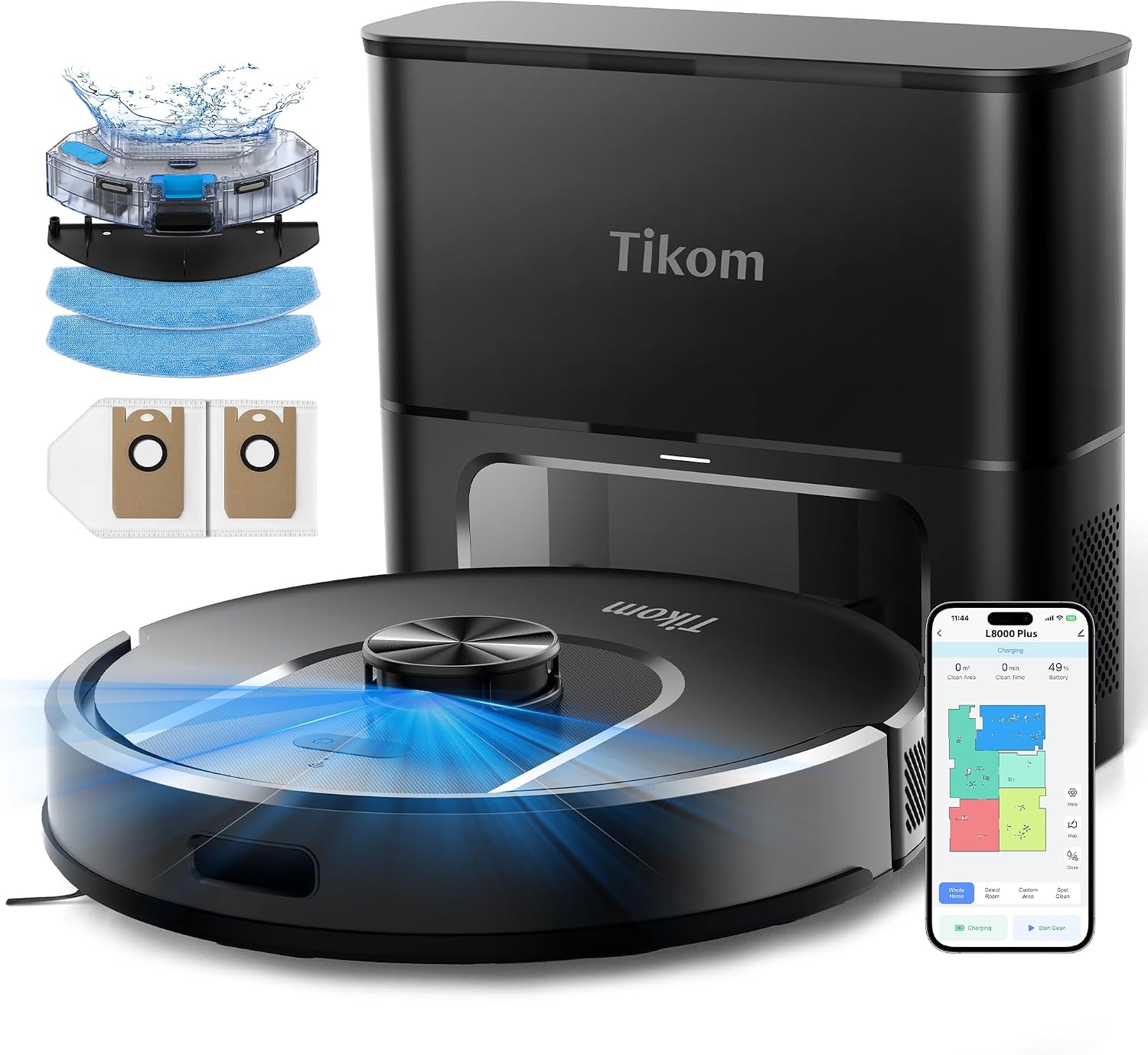
The value pick if you want hands-off emptying without a premium price. It pairs 6,000Pa suction with 360° LiDAR mapping, so navigation is more reliable than most budget bots. The 3L self-empty bag is rated to hold debris for up to 90 days, and it stores up to 5 maps for multi-room homes.
Tikom’s hasa 6,000Pa maximum suction, a 3L self-emptying bag with an up-to-90-day claim, 360-degree LiDAR mapping, support for up to five maps, three suction levels, three water-flow settings, and recharge-and-resume cleaning.
Its appeal is value rather than premium automation. The LiDAR mapping is a meaningful step up from random or basic zig-zag navigation, and the self-empty dock reduces how often I handle a bin full of fur. The trade-offs are a simple drag-style mop, no advanced camera-based object recognition, and a conventional brush that can still collect long hair, so heavy-shedding homes should expect more roller maintenance than with Dreame or ECOVACS.
Key Features
- 6,000Pa maximum suction. A strong published figure for a budget mapping robot.
- 3L self-emptying dust bag. Tikom claims up to 90 days between bag changes under light-use conditions.
- 360-degree LiDAR mapping. Creates repeatable maps with room, no-go, no-mop, and virtual-wall controls.
- Up to five saved maps. Useful for multi-level homes when the robot is moved between floors.
- Three suction and water levels. Lets the cleaning routine be adjusted for hard floors, carpets, and mopping.
- Up to 150-minute runtime. Supports recharge and resume when a cleaning job is not finished.
Pros
- Very good feature value. LiDAR plus self-emptying is uncommon at this price.
- Strong daily pet-hair usefulness. It can keep loose fur under control when scheduled often.
- Good mapping controls. Room selection and virtual boundaries are much easier to live with than non-mapping bots.
- Less daily bin handling. The base makes frequent pet-hair cleaning more practical.
- Broad Wi-Fi and voice support. App, Alexa, and multi-band network support add flexibility.
Cons
- Long hair can still tangle. The conventional brush is not as maintenance-friendly as premium anti-tangle systems.
- Mopping is basic. It is better for light wipe-downs than dried paw marks or sticky residue.
- No advanced object recognition. Cables, toys, socks, and pet accidents should be cleared before a run.
Final Verdict: The Tikom L8000 Plus is the model I would buy on a tighter budget when self-emptying and LiDAR matter more than premium mopping. It is a genuinely useful pet-hair maintenance robot, but owners of long-haired pets should expect regular brush cleaning.
4. Roborock Q7 M5+ – Best Value for LiDAR Mapping and Mixed Floors

A smart middle-ground pick for homes with a mix of rugs and hard floors. PreciSense LiDAR maps quickly and accurately, and the Dual Anti-Tangle system helps keep pet hair from wrapping the brush. Its auto-empty dock is rated to run for about seven weeks between empties.
The Roborock Q7 M5+ combines 10,000Pa claimed HyperForce suction, PreciSense LiDAR navigation, carpet boost, a self-emptying dock, three water-flow levels, and Roborock’s Dual Anti-Tangle System. The plus version adds the auto-empty base, which Roborock currently markets for up to seven weeks of hands-free dust collection.
I like the Q7 M5+ most for buyers who want Roborock’s mapping and app experience without paying for an Ultra dock. It is efficient and easy to schedule by room, but it is not a true clutter-avoidance robot because it lacks camera-based object recognition. Its anti-tangle system reduces some maintenance, yet long hair can still wrap around the main brush, and the static mop does not lift over carpet.
Key Features
- 10,000Pa HyperForce suction. Strong claimed suction for daily dust, crumbs, litter, and loose pet hair.
- Dual Anti-Tangle System. Uses brush and side-brush design features intended to reduce hair wrapping.
- PreciSense LiDAR. Provides accurate room maps, schedules, no-go zones, and multi-level mapping.
- Auto Boost on Carpet. Raises suction when carpet cleaning is needed.
- Three water-flow levels. Allows basic mopping intensity to be adjusted in the app.
- Auto-empty dock. Reduces manual bin emptying and supports longer unattended routines.
Pros
- Excellent app and mapping experience. Roborock’s room controls are easy to build into a pet-home schedule.
- Strong value for the feature set. You get LiDAR, high claimed suction, mopping, and self-emptying without a flagship price.
- Good mixed-floor vacuuming. It handles hard floors and ordinary carpet maintenance well.
- Useful carpet boost. Makes regular fur pickup on rugs and carpet more practical.
- Compact self-empty system. The dock is less complex than full wash-and-dry stations.
Cons
- No advanced obstacle recognition. Floor clutter and pet waste must be removed before cleaning.
- Long hair can still wrap around the main brush. The anti-tangle label does not eliminate manual roller maintenance.
- Static mop does not lift. Mixed homes need no-mop zones or manual mop management around carpet.
Final Verdict: The Roborock Q7 M5+ is a strong value if you prioritize mapping, scheduling, self-emptying, and general mixed-floor cleaning. I would not make it my first choice for a cluttered home with heavy long-haired shedding because obstacle avoidance and hair wrap are its weaker areas.
5. MOVA P10 Pro Ultra – Best for Hard Floors, Paw Marks, and Obstacle Avoidance
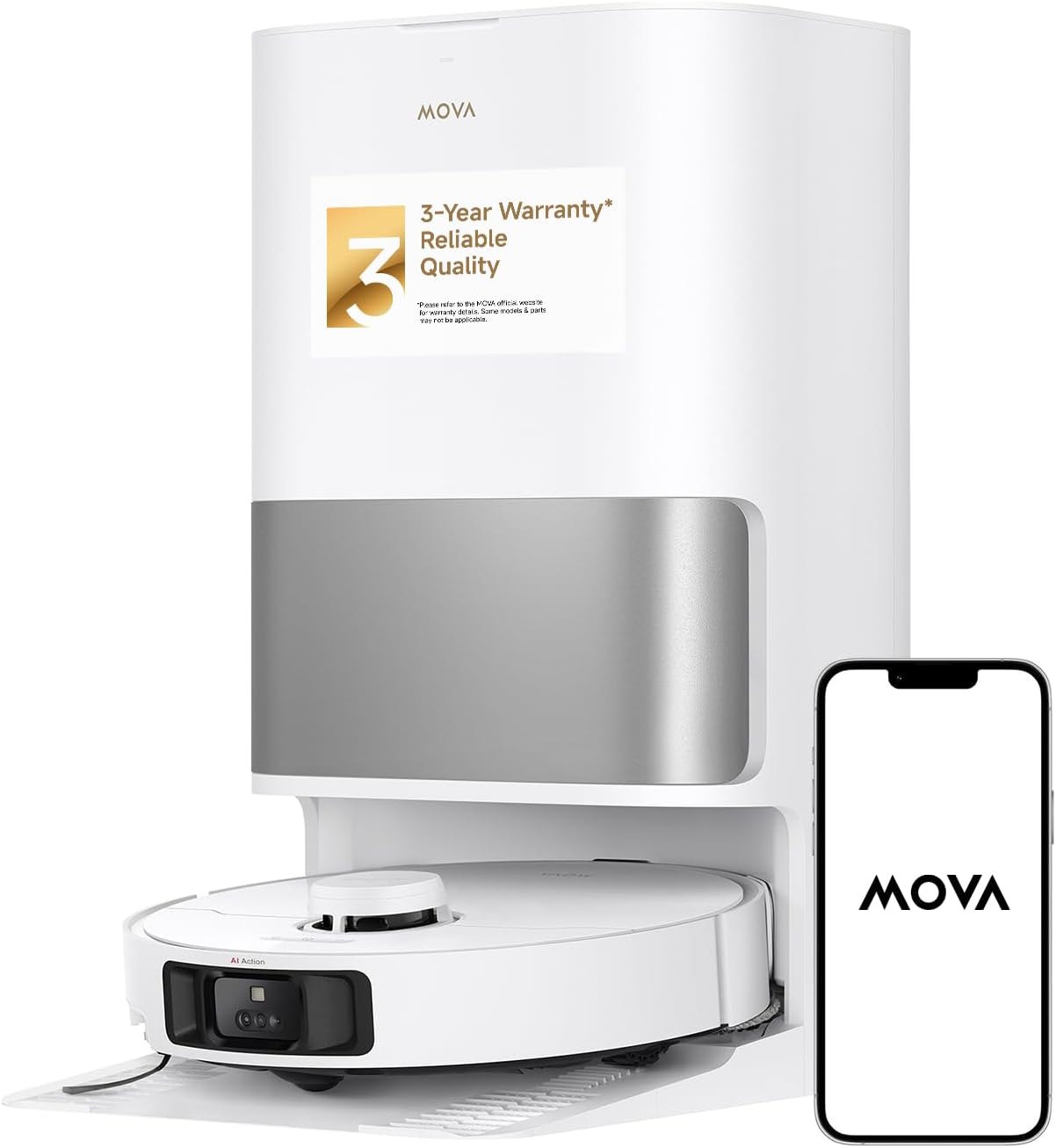
The pick for hard-floor homes with toys, cords, and clutter to dodge. An RGB camera plus 3D structured light gives it sharp obstacle avoidance, while dual spinning mops with a 10.5mm lift scrub hard floors and clear carpet. A full-service dock handles emptying, washing, and refilling.
The MOVA P10 Pro Ultra is a better match for hard-floor pet homes than its headline suction number alone suggests. MOVA has 13,000Pa suction, an extendable side brush and mop, dual rotary mops, 10.5mm mop lifting, an RGB camera with 3D structured-light obstacle avoidance, smart dirt detection, and a full-service dock that auto-empties, refills water, washes the pads with hot water, and dries them with hot air.
I like the P10 Pro Ultra when clutter and hard-floor cleanup are bigger problems than deeply embedded carpet fur. Its edge reach is useful around walls and feeding areas, and the obstacle system is one of its best ownership features. The main limitation for this guide is carpet pet hair: the standard brush is not the strongest agitator for fur pressed into carpet, and MOVA’s optional TriCut detangling brush is sold separately rather than included as standard.
Key Features
- 13,000Pa maximum suction. Designed for fur, litter, crumbs, and normal household debris.
- FlexReach edge cleaning. Extending side brush and mop reach farther into edges and corners.
- 10.5mm mop lifting. Helps keep wet pads off compatible carpet and rugs.
- RGB camera + 3D structured light. Provides advanced obstacle recognition and navigation.
- Smart dirt detection. Can trigger mop rewashing and remopping when the system identifies dirtier areas.
- All-in-one dock. Auto-emptying, water refill, hot-water mop washing, hot-air drying, and washboard cleaning reduce daily maintenance.
Pros
- Excellent hard-floor ownership experience. Strong edge reach, obstacle avoidance, and automated mopping suit paw-mark-heavy homes.
- Advanced obstacle handling. A major advantage where pet toys and cables are common.
- Full-service dock. Handles most repetitive mop and dust maintenance.
- Good carpet protection. The mops lift rather than dragging wet pads across rugs.
- Pet monitoring features. Video and pet-oriented app functions may be useful for some households.
Cons
- Embedded carpet pet hair is not its strongest job. The standard roller can leave more hair in carpet than premium pet-focused competitors.
- Optional detangling brush costs extra. The TriCut brush is not standard on the base configuration.
- Large dock footprint. The full-service base needs more space and periodic tank, bag, and pad care.
Final Verdict: The MOVA P10 Pro Ultra is my choice for pet homes with mostly sealed hard floors, frequent paw marks, and plenty of clutter. I would choose a different model if embedded carpet fur is the main problem, but its obstacle handling and dock automation are excellent for everyday maintenance.
6. Tikom G8000 Max – Best Low-Cost Robot Vacuum and Mop for Light Pet Hair

The most affordable pick for lighter pet hair and simpler homes. It runs 5,000Pa suction with a 450ml dustbin and 300ml water tank for light vacuum-and-mop passes. A slim 2.99-inch body slides under low furniture, and up to 150 minutes of runtime covers larger floor plans on a charge.
The Tikom G8000 Max is the simplest machine in this guide, and that is also why it can make sense for a smaller home. Tikom has 5,000Pa suction, a combined 450ml dustbin and 300ml water tank, simultaneous vacuuming and mopping, up to 150 minutes of runtime in quiet mode, app and remote control, and a low 2.99-inch body that can reach under furniture.
This is not a LiDAR mapping robot and it does not include a self-emptying base, so it asks more from the owner than the other five models. I see it as a daily maintenance machine for loose pet hair on hard floors, crumbs, and light carpet cleaning rather than a fully autonomous system. Its basic zig-zag route and sensor navigation are easier to justify in apartments and simpler layouts than in large, cluttered, multi-room homes.
Key Features
- 5,000Pa claimed suction. Useful for loose fur, dust, crumbs, and everyday debris at a low price.
- 450ml dustbin + 300ml water tank. Supports vacuuming and mopping in the same run.
- Up to 150-minute runtime. Automatically returns to recharge when battery is low.
- Four control methods. App, remote, voice, and onboard buttons provide flexible operation.
- Four cleaning modes. Spot, Edge, Zig-zag, and Manual modes cover simple daily routines.
- 2.99-inch slim body. Can reach under lower beds, sofas, and cabinets more easily than tall LiDAR robots.
Pros
- Low purchase cost. A practical way to automate daily fur pickup without a premium investment.
- Slim design. Useful for collecting hair under furniture where a stick vacuum may not reach daily.
- Simple controls. Remote and button operation help users who do not want to rely only on an app.
- Good hard-floor maintenance. Loose fur and crumbs are the type of mess it handles best.
- Long claimed runtime for the price. Suitable for apartments and smaller single-level homes.
Cons
- No LiDAR room mapping. You do not get the same room-specific control, repeatability, or virtual-zone precision.
- No self-empty dock. Heavy shedding can fill the onboard bin quickly and require frequent emptying.
- Basic mopping and carpet performance. It is better for light maintenance than deep stain scrubbing or embedded fur.
Final Verdict: The Tikom G8000 Max is the budget pick for light pet hair, hard floors, and simpler layouts where advanced mapping is not essential. It saves money upfront, but you trade away self-emptying, LiDAR mapping, premium obstacle avoidance, and stronger carpet performance.
Which Robot Vacuum Is Best for Your Pet and Flooring?
The six models make more sense when I match them to the mess instead of ranking them only by price. A long-haired dog on carpet creates a different problem from two short-haired cats in a hard-floor apartment.
- Heavy shedding on carpet. Start with Dreame L60 Ultra PE or ECOVACS T90 PRO OMNI because brush design and hair management are more important than mop sophistication.
- Mostly hard floors with paw marks. ECOVACS T90 PRO OMNI or MOVA P10 Pro Ultra are stronger choices when mopping and edge cleaning are frequent jobs.
- Cluttered floors with toys and cables. Dreame, ECOVACS, and MOVA provide more advanced obstacle recognition than the budget LiDAR or sensor-only options.
- Budget home with heavy daily fur. Tikom L8000 Plus gives you LiDAR and self-emptying at a lower price, but expect more brush maintenance.
- Roborock app preference. Q7 M5+ is a good value when mapping and scheduling matter and you can clear small obstacles before runs.
- Apartment with light shedding. Tikom G8000 Max is enough if you mainly want daily loose-hair pickup and basic mopping.
If allergies are part of the household problem, do not rely on the robot alone. A robot keeps floors cleaner, but upholstered furniture, stairs, pet beds, vents, and deep carpet still benefit from a sealed full-size or cordless vacuum.
How to Choose the Best Robot Vacuum and Mop for Pet Hair
I choose a pet-hair robot by working backward from the home rather than forward from the product page. The steps below keep the decision focused on maintenance and floor compatibility.
1. Identify where the hair actually collects. Carpet, rugs, hard floors, edges, under furniture, and feeding areas need different cleaning strengths.
2. Match the brush to the hair length. Long hair needs better tangle control than short loose fur on hard flooring.
3. Decide how much floor prep you will tolerate. If toys and cables stay out, pay more for obstacle avoidance. If you tidy before every run, a budget LiDAR robot may be enough.
4. Choose the right mop style. Roller and spinning-pad systems are better for regular hard-floor scrubbing; drag mops are mainly maintenance tools.
5. Price the dock and consumables. Bags, filters, pads, detergent, replacement brushes, and optional anti-tangle accessories affect long-term cost.
6. Check carpet behavior. Look for mop lift, carpet boost, no-mop zones, and whether the side brush remains active on carpet.
7. Measure the dock location. Premium bases need enough floor area, wall clearance, power, and convenient access to water tanks and dust bags.
8. Build a realistic schedule. Daily or near-daily runs usually control pet hair better than an occasional maximum-suction clean.
The best robot is the one you can schedule frequently without needing to rescue, clean, refill, or untangle it after every run.
Pet-Hair Robot Vacuum Maintenance
Self-emptying does not mean maintenance-free. Pet hair is unusually good at finding brush ends, wheel axles, filters, seals, and narrow airflow paths, so a short inspection routine keeps performance more consistent.
- Inspect the main brush weekly. Cut or pull away wrapped hair before it tightens around the axle or end caps.
- Check the side brush and wheels. Long hair can wrap where it is less visible and eventually affect rotation.
- Clean sensors and LiDAR windows. Dust and pet dander can reduce navigation or obstacle-detection reliability.
- Change or clean filters on schedule. A clogged filter can reduce airflow and make the robot work harder.
- Wash and dry mop pads. Premium docks automate this, but pads still need replacement once worn or permanently stained.
- Empty dock bags and dirty-water tanks before they are overfull. Pet hair compacts heavily, and dirty mop water can develop odor if ignored.
- Replace worn brushes. A deformed or polished roller cannot agitate carpet and collect hair as effectively.
I would rather spend five minutes on preventive maintenance every week than wait for a clogged brush, bad odor, or navigation failure to stop the whole cleaning routine.
Common Mistakes to Avoid With Robot Vacuums in Pet Homes
Most disappointing robot-vacuum experiences come from expecting the machine to solve a problem it was not designed to handle. The biggest pet-home mistakes are predictable and easy to avoid.
- Buying by suction number alone. A 30,000Pa claim does not automatically beat a lower-number robot on pet hair because brush design, airflow, contact, and software differ.
- Ignoring hair-wrap maintenance. Even anti-tangle systems should be inspected regularly, especially with long-haired pets or people.
- Running the robot over a real pet accident. Obstacle detection is not reliable enough to make this safe. Clean accidents manually before the robot runs.
- Assuming every mop protects carpet. Some robots need no-mop zones or manual pad removal because the mop does not lift.
- Putting the dock in a cramped corner. Poor clearance can make docking, emptying, and tank access less reliable.
- Skipping the first supervised runs. Watch the robot map the home so you can fix cables, thresholds, black rugs, trapped areas, and bad no-go zones.
- Expecting the robot to replace deep carpet cleaning. Daily automation controls buildup, but a full-size vacuum is still better for stairs, upholstery, pet beds, and deep embedded hair.
- Forgetting replacement costs. Dust bags, mop pads, filters, side brushes, cleaning solution, and specialty anti-tangle brushes can change the real value.
- Using wet mopping on unsuitable floors. Follow the flooring manufacturer’s care guidance, especially for unsealed wood, moisture-sensitive laminate, and rugs.
A robot is most valuable when its job is clearly defined: frequent floor maintenance. Keep pet accidents, deep upholstery cleaning, and periodic manual edge work outside that job, and the automation becomes much more dependable.
Final Verdict: Best Robot Vacuum and Mop for Pet Hair
The Dreame L60 Ultra PE is my best overall robot vacuum and mop for pet hair because it combines the features that reduce the most real work: strong hair management, broad obstacle recognition, carpet-aware mopping, edge reach, and an all-in-one dock. The ECOVACS DEEBOT T90 PRO OMNI is the stronger premium choice if roller mopping and premium obstacle avoidance are just as important as fur pickup.
On a tighter budget, the Tikom L8000 Plus gives you the biggest convenience jump through LiDAR and self-emptying, while the Roborock Q7 M5+ is the better app-and-mapping value for buyers who can keep floors clear. MOVA P10 Pro Ultra fits hard-floor and cluttered homes well, and Tikom G8000 Max is the simple low-cost option for light shedding.
Whichever model you choose, schedule it often and maintain the brushes. In a pet home, the best robot is not the one that wins one maximum-power test. It is the one that keeps running without turning hair, clutter, wet pads, or dock maintenance into another daily chore.
Frequently Asked Questions
What is the best robot vacuum and mop for pet hair in 2026?
For heavy shedding, I prefer the Dreame L60 Ultra PE because it combines a dual anti-tangle brush system, advanced obstacle recognition, edge-reaching hardware, carpet-aware mopping, and a highly automated dock. The ECOVACS T90 PRO OMNI is the premium alternative when strong mopping is equally important.
Do robot vacuums really work for pet hair?
Yes, especially when they run frequently. They are best at controlling daily loose fur and reducing buildup between deeper manual cleanings. Embedded carpet hair is more difficult and depends heavily on brush agitation and hair-wrap control.
Is more suction always better for pet hair?
No. Suction matters, but brush design, floor contact, airflow, carpet agitation, navigation, and cleaning frequency can have just as much effect on real pet-hair pickup.
Which robot vacuum is best for long pet hair?
Models with stronger anti-tangle systems, such as the Dreame L60 Ultra PE and ECOVACS T90 PRO OMNI, are better starting points because long hair is more likely to wrap around conventional brushes.
Can a robot vacuum avoid pet poop?
Some premium robots are designed to recognize small objects and pet-related hazards, but no avoidance system should be treated as a guarantee. Always remove real pet waste before running the robot.
Are robot vacuum mops safe for carpet?
Only when the robot can reliably lift the mop or you use no-mop zones and correct app settings. Static mops without lifting should not be allowed to drag a wet pad across carpet.
Is a self-emptying dock worth it for pet hair?
Usually, yes, if your pets shed heavily. Fur can fill a small onboard dustbin quickly, so auto-emptying makes daily schedules much easier to maintain.
How often should a robot vacuum run with pets?
Many pet homes benefit from daily or near-daily cleaning in the highest-shedding rooms. Frequent smaller runs are usually more effective than waiting for a large buildup.
Which budget robot is best for pet hair?
The Tikom L8000 Plus is my budget self-emptying choice because it adds LiDAR mapping and a large dock bag. The Tikom G8000 Max costs less but requires manual bin emptying and has simpler navigation.
Is the Roborock Q7 M5+ good for pet hair?
It is useful for general pet-hair maintenance and offers strong mapping, but long hair can still wrap around the brush and it lacks advanced obstacle recognition. I prefer it for light-to-moderate shedding rather than the heaviest pet-hair homes.
Is the MOVA P10 Pro Ultra good for pets?
It is especially good for hard-floor pet homes that need strong obstacle avoidance and automated mopping. Embedded carpet pet hair is a weaker area, so it is not my first choice for thick carpet and heavy shedding.
Can a robot vacuum and mop replace a regular vacuum?
Not completely. A robot is excellent for frequent floor maintenance, but stairs, upholstery, pet beds, tight crevices, deep carpet, and occasional heavy messes still benefit from a traditional or cordless vacuum.

